
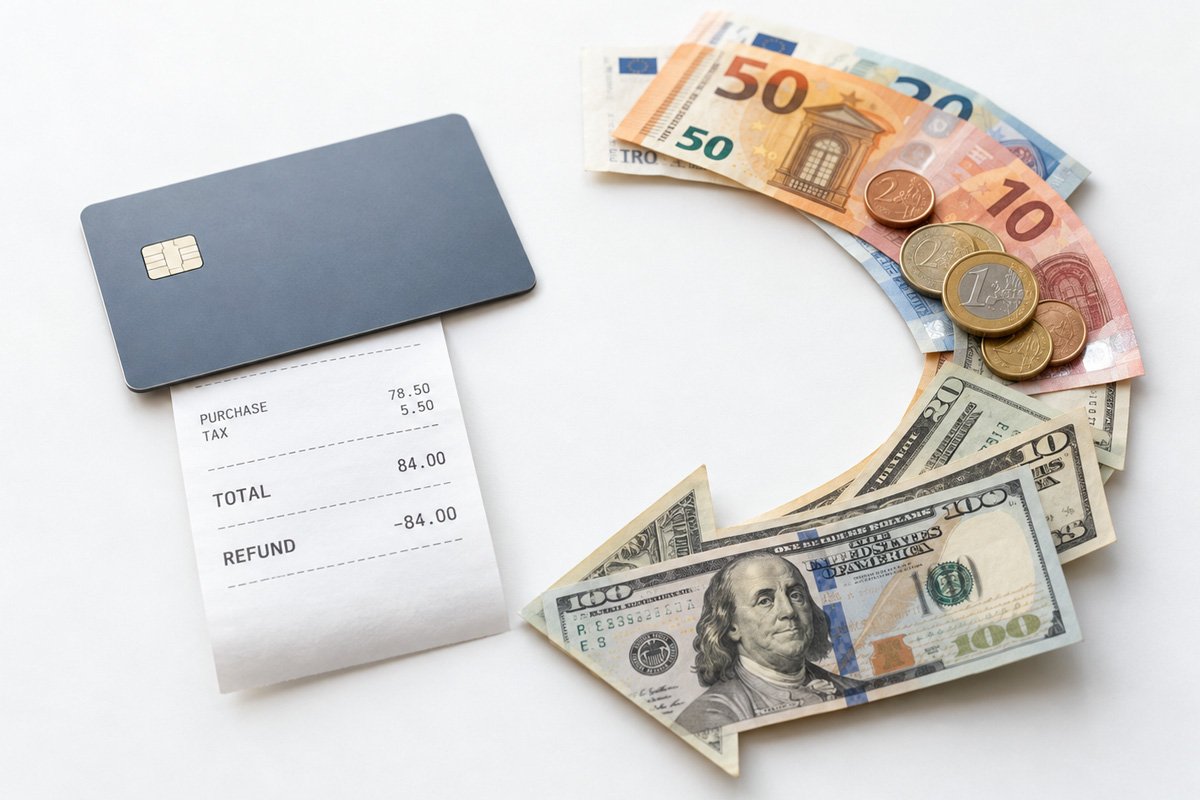
A shop confirms that it has refunded your order in full. You check your bank account, but the amount credited is smaller than the original payment.
That does not necessarily mean the shop kept some of your money. When you pay in a foreign currency, a full refund can return exactly what the retailer received without restoring exactly what left your account. The difference can come from the exchange rate, fees, or both.
How a full refund can leave you short
Suppose you buy something for $1,100 using a card linked to a euro account. At the time of payment, €1 buys $1.10, so the purchase costs you €1,000.
You return the item, and the retailer refunds the full $1,100. By the time the refund is converted, however, €1 buys $1.20. Those same dollars are now worth €916.67.
The retailer has returned every dollar, but you receive €83.33 less than you paid.
These are hypothetical rates, with fees and exchange-rate markups left out to keep the calculation simple. The point is that you bought dollars at one rate and received their euro equivalent at another.
It can also work in your favour. If the dollar strengthens against the euro between the two conversions, the refund can be worth more than the original payment.
Which exchange rate applies to the refund?
The rate used for the purchase is not necessarily the one used for the refund. The treatment depends on your card issuer or payment provider.
PayPal's UK refund guidance, for example, explains that refunds involving currency conversion can use a different exchange rate from the original payment. Mastercard's currency converter guidance also notes that your bank may use a different rate from the one shown in its calculator and may charge additional fees.
The conversion date matters too. Requesting a refund on Monday does not necessarily mean Monday's exchange rate will apply. The relevant date depends on how the provider processes the transaction.
When checking a difference, ask your provider which exchange rate and conversion date it used for each payment. Comparing the refund with today's rate will not tell you much about a conversion that happened earlier.
Are foreign transaction fees refunded?
A refund of the purchase price does not automatically include a refund of every fee.
Suppose your bank converts a payment to €100 and adds a €3 foreign transaction fee. If the retailer refunds the purchase and the bank retains that fee, you are still €3 short even without any movement in the exchange rate.
American Express's consumer guidance notes that foreign transaction fees may not be returned on refunded purchases and advises checking with the card issuer. The answer depends on your card's terms.
A card with no foreign transaction fee avoids that particular cost. It does not protect you from changes in the value of the currency.
A cancelled payment is not always a refund
Before looking for a second conversion, check whether the original payment actually completed.
A pending payment that disappears from your account is different from a completed payment followed by a separate refund. Stripe's refund documentation explains that some refunds made shortly after a charge are processed as a "reversal". In that case, the original charge disappears from the statement rather than being followed by a separate credit.
You should not assume that every cancelled order involves two completed currency conversions.
How to check what happened to your money
Start with the receipt and the merchant's refund confirmation. Compare the amount and the currency, not just the amount credited to your bank account. You can use our currency converter to see how the amount would change using exchange rates from different dates.
If you paid $1,100 and the merchant refunded $1,100, the dollar amounts match. If the merchant refunded only $1,050, an exchange-rate movement cannot explain the missing $50. Ask the shop for a breakdown first.
Then compare the completed payment and refund in your banking app. Look for any separately listed fees and check whether the transaction details show the exchange rates used. Where that information is missing, ask the provider.
You can also use the historical currency converter on xrates.eu to compare the value of the same foreign-currency amount on two different dates. This helps show whether the market moved in a direction that could explain the difference.
Treat that comparison as a reference, not proof that the bank made a mistake. The ECB states that its reference rates are published for information purposes. They are not rates that your card issuer must apply, and a difference from the ECB rate does not by itself establish a hidden fee.
Does a multi-currency account solve the problem?
It can avoid an immediate conversion, provided the account supports both the payment and the refund in the same currency.
For example, NatWest's Travel account guidance says merchant refunds in a supported account currency return to that currency account. Under that arrangement, a $1,100 payment from a dollar balance can be followed by a $1,100 refund into the same balance.
You get the same number of dollars back. Their value in euros can still change, though. Converting them later does not guarantee recovering the euros you originally spent to buy them.
Paying in euros at a foreign checkout is not an automatic solution either. When you accept dynamic currency conversion, the merchant or its provider handles the exchange. Mastercard notes that its exchange rates do not apply to that conversion. Our article "The Card Machine Asked Me: Pay in Euros or My Own Currency?" explains that choice in more detail.
For an expensive purchase you might return, it is worth asking your card provider beforehand: "Will a full refund restore the original amount in euros, or will the foreign-currency amount be converted again?"
Once a refund has arrived, the first check is simpler: did the shop return fewer dollars, or did the same dollars come back worth fewer euros?