Europe Was Bigger Than the U.S. Economy in 2008. What Happened?
11.08.2026 Mara Ellison
In 2008, the European Union looked stronger than the United States in simple GDP terms.
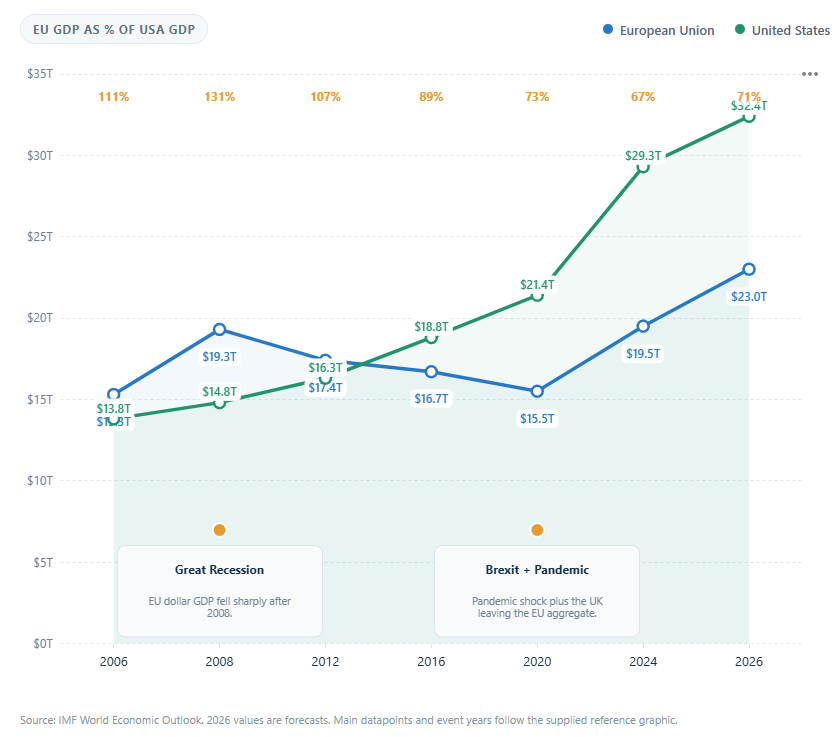
The EU economy was worth about $19 trillion, while U.S. GDP was around $15 trillion. The euro was also extremely strong, at one point trading close to $1.60.
In 2026, the situation looks very different.
U.S. GDP is expected to reach roughly $32.4 trillion, while the European Union is around $23 trillion. Europe is now only about 70% of the size of the U.S. economy when both are measured in current dollars.
That sounds dramatic, but the comparison needs some context.
The exchange rate explains part of the gap
GDP converted into dollars moves with the exchange rate.
In 2008, the euro was unusually strong. Today it trades much lower against the dollar. That alone makes European GDP look smaller in dollar terms, even if the underlying economy has not shrunk by the same amount.
There is also Brexit.
The United Kingdom was still part of the EU in 2008. Today it is not. Removing one of Europe's largest economies naturally reduces the EU total.
Even after accounting for those two factors, however, the U.S. has clearly grown faster.
America's productivity advantage
One of the biggest differences is productivity.
Between late 2019 and mid-2024, labour productivity per hour worked increased by only about 1% in the euro area, compared with almost 7% in the United States.
The U.S. has also invested much more heavily in technology, software, data centres and artificial intelligence.
Europe still has major companies in manufacturing, pharmaceuticals, aerospace and luxury goods, but it has produced far fewer global technology giants.
That matters because investment in technology eventually shows up in higher output per worker.
Europe also has an energy problem
The war in Ukraine exposed another weakness.
For years, much of European industry benefited from relatively cheap Russian energy. Germany in particular built a successful model around cheap energy, exports and strong demand from China.
That model became much harder to maintain after 2022.
European companies now often pay significantly more for electricity and gas than competitors in the United States, where domestic energy production is much stronger.
For energy-intensive industries, that difference can decide where future investment goes.
The U.S. has deeper capital markets
Europe has plenty of savings, but it is less effective at turning them into large companies.
American firms have access to a much deeper and more unified capital market. A company in the U.S. can raise money and expand inside one huge domestic market.
Europe is still more fragmented.
Different regulations, financial systems and national markets make it harder for young companies to scale quickly.
This is one reason so many of the world's biggest technology companies are American.
America is also spending more
There is another side to stronger U.S. growth.
The American government is running much larger budget deficits.
In 2026, the U.S. deficit is expected to remain above 7% of GDP, while the EU average is much lower.
That fiscal spending supports economic activity, but it also pushes U.S. public debt higher.
So the American model is not simply better productivity and better technology. Part of the stronger growth is also being financed through borrowing.
Europeans work fewer hours
Another part of the income gap has little to do with efficiency.
Europeans generally work fewer hours than Americans.
ECB estimates suggest that if euro-area employees worked as many hours as U.S. workers, the difference in GDP per capita would be much smaller.
That does not necessarily mean Europeans should work more.
GDP measures economic output. It does not measure free time, holidays or quality of life particularly well.
Europe is not collapsing
The idea that Europe is simply in permanent decline is too simplistic.
The EU economy is still growing. Unemployment remains relatively low, and several European economies have performed well in recent years.
The real problem is relative growth.
The United States has benefited from stronger productivity, cheaper energy, deeper capital markets, a much larger technology sector and more aggressive government spending.
Europe has also faced an unusually difficult sequence of shocks: the financial crisis, the eurozone debt crisis, Brexit, the pandemic and the energy crisis after Russia's invasion of Ukraine.
So the headline chart is real, but it should not be read too literally. Part of the gap comes from exchange rates and Brexit. The more important issue is productivity. Currencies can recover. Energy prices can fall.
But if one economy keeps producing more value from every hour of work, the difference grows year after year.
Currency converter
Also try our advanced currency
converter which can convert using the European Central Bank (ECB) reference exchange rate from a previous date.